How Hard Water Destroys Your Coral Gables Plumbing (And How to Stop It)
If you live in Coral Gables — whether in a sprawling Gables Estates estate, a Cocoplum waterfront home, or a mid-century bungalow in the 33134 zip code — there is an invisible enemy slowly attacking your plumbing system every single day. It flows silently through every pipe in your house, coats every fixture in a chalky white crust, and steadily chokes the life out of your appliances, water heater, and supply lines. That enemy is hard water, and the Miami-Dade region is one of the worst areas in the entire country for it.
Most homeowners in Coral Gables, 33146, Deering Bay, and the surrounding communities do not realize hard water is causing damage until the repair bills start piling up. By then, scale has already built up inside pipes, water heaters are running at a fraction of their efficiency, and shower fixtures are clogged beyond cleaning. This guide will explain exactly what hard water is, why South Florida's water supply is so mineral-dense, what hard water does to your plumbing system over time, and — most importantly — what you can do to stop it before the damage becomes catastrophic.
What Is Hard Water and Why Is Coral Gables So Affected?
Hard water is water that contains high concentrations of dissolved minerals, primarily calcium (Ca²⁺) and magnesium (Mg²⁺). Water hardness is measured in grains per gallon (GPG) or milligrams per liter (mg/L). Water measuring 7–10.5 GPG is considered hard; anything above 10.5 GPG is classified as very hard. Miami-Dade County's municipal water supply routinely tests in the range of 10 to 14 GPG — firmly in the "very hard" category.
The reason South Florida's water is so mineral-heavy comes down to geology. Miami-Dade County draws its potable water supply primarily from the Biscayne Aquifer, a shallow, highly porous limestone formation that underlies most of South Florida. As rainwater percolates through the porous limestone bedrock over time, it dissolves calcium carbonate and magnesium carbonate directly from the rock, picking up a heavy mineral load before it ever reaches a treatment plant. While the Miami-Dade Water and Sewer Department (WASD) treats this water to meet federal Safe Drinking Water Act standards, they do not remove the dissolved calcium and magnesium — because these minerals are not a health hazard, only a plumbing hazard.
What leaves the treatment plant is delivered through the distribution system to homes in Gables Estates, Cocoplum, Deering Bay, and throughout zip codes 33134 and 33146 carrying its full mineral load intact. The moment that water slows down, heats up, or loses pressure inside your plumbing system, those dissolved minerals begin to crystallize and deposit as calcium carbonate scale — the white, gritty, rock-hard crust you see on your showerheads, faucets, and around your toilet bowl ring.
6 Devastating Ways Hard Water Damages Your Plumbing System
The damage caused by hard water in Coral Gables homes is both widespread and cumulative. Each form of damage compounds the others. Here are the six most serious ways hard water is working against you right now.
1. Scale Buildup Inside Supply Pipes (Reduced Flow and Pressure)
Calcium carbonate scale does not only form on surfaces you can see — it builds up relentlessly inside your supply pipes. Every time hot or pressurized water passes through copper, galvanized steel, or CPVC piping, a thin film of mineral deposits is left behind. Over the course of years and decades, these deposits layer on top of each other, progressively narrowing the inner diameter of your pipes in a process that plumbers call scaling or pipe calcification.
In older homes in Coral Gables — particularly pre-1980 construction common in 33134 and 33146 — galvanized steel pipes are already prone to internal corrosion. When you add a heavy hard-water scaling problem on top of existing corrosion products, the pipe interior can become severely restricted. The result is chronically low water pressure throughout the home, reduced flow at faucets and shower heads, and eventually complete blockage of small-diameter branch lines. In extreme cases, the only solution is a full whole-home repipe.
2. Water Heater Efficiency Loss and Premature Failure
Your water heater is the single appliance most devastated by hard water. Because it heats water to temperatures between 120°F and 140°F, it dramatically accelerates the precipitation of calcium carbonate from solution. Scale accumulates rapidly on the bottom of the tank and — in tankless models — directly on the heat exchanger surfaces.
The U.S. Department of Energy has documented that a mere 1/4 inch of scale on a tank water heater's heating element increases energy consumption by up to 40%. A scale-coated tankless water heater can see flow rates drop by 25–30% and may fail entirely within 5–7 years instead of the expected 20+ year service life. In Coral Gables, where homes in Gables Estates and Deering Bay may run 75-gallon or larger water heaters, this translates directly into hundreds of dollars per year in wasted energy and thousands in premature replacement costs.
3. Fixture and Faucet Clogging
Aerators on kitchen and bathroom faucets are the first visible casualties of hard water. These small mesh screens trap the calcium carbonate particles that break free from scale deposits inside pipes, eventually clogging to the point where water flow is severely restricted. The same process attacks showerhead nozzles, which become encrusted with mineral deposits that redirect spray patterns, reduce flow, and eventually seize the adjustment mechanisms entirely.
Ball valves, angle stops under sinks, and toilet fill valves are also vulnerable. Scale deposits can cause these valves to seize in the open or closed position, making it impossible to shut off water during a plumbing emergency — a potentially catastrophic situation. Replacing scale-fused angle stops is one of the most common service calls we handle throughout Coral Gables.
4. Dishwasher and Washing Machine Damage
Major appliances connected to your water supply are equally vulnerable. In dishwashers, hard water leaves a permanent cloudy film on glassware and dishes (often mistaken for detergent residue), clogs spray arm nozzles, and deposits scale inside the pump, heating element, and water inlet valve. This dramatically shortens appliance life and forces homeowners to use far more detergent than necessary.
In washing machines, particularly front-load models common in upscale Cocoplum and Deering Bay homes, hard water interacts with detergent to form a sticky soap scum (calcium stearate) that coats drum surfaces, hoses, and internal components. This residue traps bacteria and mold — contributing to the notorious front-loader odor problem — while also causing premature seal and pump failure.
5. Calcium Carbonate Scale Accelerates Pinhole Leaks in Copper Pipe
Here is a mechanism that surprises most homeowners: while hard water scale might seem like it would coat and protect copper pipes, it actually sets the stage for a dangerous form of corrosion called pitting corrosion. In South Florida, Miami-Dade WASD treats water with chloramines (a combination of chlorine and ammonia) as a disinfectant. Chloramines are more chemically stable than free chlorine, but they are significantly more corrosive to copper piping.
When chloramine-treated water flows through copper pipes, the chloramine attacks the copper surface, especially at points where scale deposits have created uneven surfaces and localized pH variations. This leads to the formation of microscopic pits in the copper wall — pitting corrosion — that eventually penetrate the pipe wall entirely, creating pinhole leaks. These tiny leaks can spray water inside wall cavities and attic spaces for weeks before visible water damage appears, resulting in catastrophic mold growth and structural damage. Homes in the 33134 and 33146 zip codes built between 1970 and 1995 with original copper plumbing are especially at risk.
6. Toilet and Shower Tile Grout Degradation
Hard water attacks the surfaces of your bathrooms as aggressively as it attacks the hidden plumbing. Calcium and magnesium deposits etch into porcelain toilet surfaces over time, making them porous and far more difficult to clean. The same deposits penetrate the unsealed surfaces of shower tile grout, creating a rough substrate that harbors mold and mildew. In high-end Coral Gables homes with natural stone tile — marble and travertine are extremely popular in Gables Estates — the acidic cleaning products homeowners use to remove scale deposits can cause irreversible etching to the stone surface itself.
Water Softeners: The Most Effective Defense Against Hard Water Coral Gables
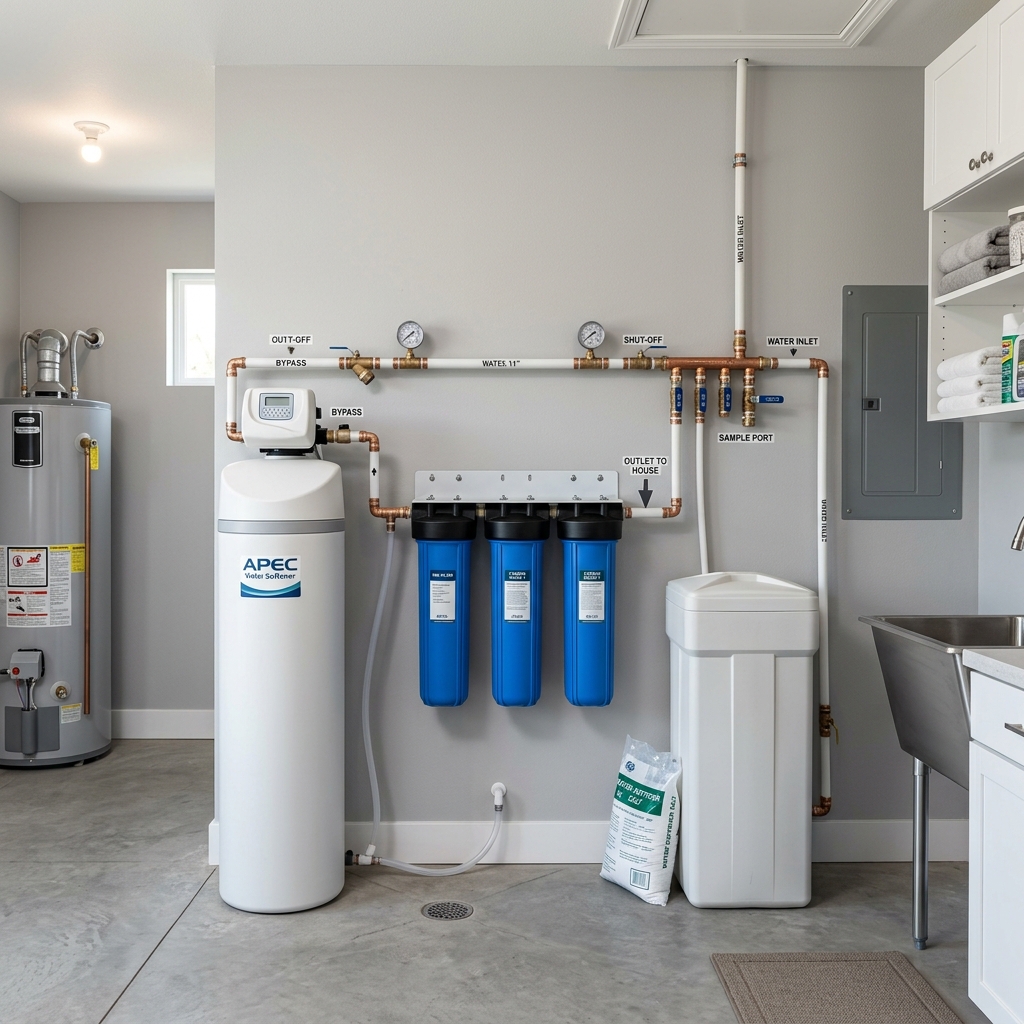
A whole-home ion-exchange water softener is the gold standard solution for hard water in Coral Gables. Here is how the technology works: a water softener tank is filled with thousands of tiny resin beads that carry a negative electrical charge. Calcium and magnesium ions, which carry a positive charge, are attracted to these beads and bind to them as your household water flows through the tank. In exchange — hence "ion exchange" — the beads release sodium ions into the water. The sodium concentration added is minimal (typically 20–30 mg/L) and not a health concern for most people.
The resin beads periodically need to be regenerated by flushing them with a concentrated brine (salt-water) solution, which recharges the beads and flushes the captured calcium and magnesium down the drain. Modern demand-initiated regeneration systems only regenerate when needed, conserving salt and water compared to older timer-based models.
A properly sized water softener — typically 32,000 to 64,000 grain capacity for most Coral Gables homes — will:
- Eliminate scale buildup in all pipes, water heaters, and appliances
- Extend water heater life by 10–15 years
- Reduce water heating energy costs by 25–40%
- Eliminate spotting on dishes, glassware, and fixtures
- Reduce soap and detergent usage by up to 50%
- Protect appliances from premature failure
Our team at Plumbing Coral Gables FL installs whole-home water softeners with full compliance to Miami-Dade WASD plumbing code requirements, including proper discharge line routing and backflow prevention. Learn more about our water filtration and softener installation services.
Carbon Block Filters: Eliminating Chloramine Damage
While water softeners address hardness minerals, they do not remove chloramines from the water supply. For comprehensive pipe and appliance protection — and for the best-tasting, healthiest drinking water — a carbon block filter should be used in conjunction with your water softener system.
Carbon block filters use densely compressed activated carbon to trap chloramines, chlorine, volatile organic compounds (VOCs), sediment, and a wide range of other contaminants through both mechanical filtration and chemical adsorption. Unlike granular activated carbon (GAC) filters, carbon block filters have a much tighter pore structure that prevents channeling — where water finds a path of least resistance through the carbon media — ensuring consistent contaminant removal throughout the filter's service life.
A whole-home carbon block filter installed at the point of entry dramatically reduces chloramine contact time with your copper piping, slowing or halting pitting corrosion. It also improves the taste and odor of water throughout the home, eliminates the "swimming pool" smell common with chloramine-treated Miami-Dade water, and reduces the formation of disinfection byproducts (DBPs) such as trihalomethanes (THMs).
Reverse Osmosis Systems: Precision Purification for Drinking Water
For drinking and cooking water of the highest possible purity, a reverse osmosis (RO) under-sink system is the ultimate solution. RO systems force water through a semi-permeable membrane with pores so small (approximately 0.0001 microns) that virtually all dissolved solids are rejected — including calcium, magnesium, sodium (left by the softener), chloramines, nitrates, heavy metals including lead, and pharmaceutical trace compounds.
A typical under-sink RO system in a Coral Gables kitchen includes:
- Stage 1 — Sediment pre-filter: Removes particles, rust, and sediment that could damage the RO membrane
- Stage 2 — Carbon block pre-filter: Removes chloramine and chlorine that would degrade the RO membrane
- Stage 3 — RO membrane: Rejects up to 99% of total dissolved solids (TDS), including all hardness minerals
- Stage 4 — Post carbon polishing filter: Removes any residual taste or odor before water reaches your glass
- Storage tank: Holds 2–4 gallons of purified water under pressure for immediate on-demand use
RO systems are particularly popular in Deering Bay and Gables Estates homes where homeowners want the cleanest possible water for cooking, ice makers, and drinking. They can also be connected directly to a refrigerator's ice and water dispenser line for crystal-clear, great-tasting ice. Our water filtration specialists can help you design a whole-home or point-of-use filtration system tailored to your household's specific needs and water chemistry.
How Hard Water Relates to Your Pipe Material — and When to Consider Repiping
The combination of hard water scale and chloramine corrosion is particularly lethal to certain pipe materials common in older Coral Gables homes. If your home in the 33134 or 33146 zip code was built before 1985, it may contain:
- Galvanized steel pipe: Already prone to rust and internal corrosion, galvanized pipe becomes a scale magnet. Once scale and corrosion combine, water pressure plummets and discolored, rusty water becomes a chronic issue.
- Polybutylene pipe (PB): Used extensively from the mid-1970s through the mid-1990s, polybutylene reacts chemically with chlorine and chloramine in municipal water, causing the pipe to become brittle and crack from the inside out. PB pipes have been the subject of major class-action litigation and are considered a defective product.
- Original copper with hard water damage: Copper that has suffered years of pitting corrosion from chloramine exposure may have pipe walls too thin to be reliably repaired — requiring full replacement.
In these situations, installing a water softener and filtration system is the right long-term move, but the existing pipes may be too far gone to benefit. A professional assessment by our licensed plumbers can determine whether your piping system is salvageable with treatment alone or whether a complete whole-home repipe is the smarter investment. We specialize in whole-home PEX-A repiping for Coral Gables homes of all ages and architectural styles, using attic-routing methods that preserve historic facades and interiors.
Signs You Have a Hard Water Problem in Your Coral Gables Home
If you are unsure how serious your hard water situation is, watch for these telltale signs:
- White or off-white chalky deposits on faucets, showerheads, and around drain openings
- Cloudy or spotted dishes and glassware after dishwasher cycles
- Soap that doesn't lather well in the shower or at the sink
- Stiff, scratchy laundry even after using fabric softener
- Reduced water pressure or flow at one or more fixtures
- A rumbling or popping sound from your water heater (scale sediment on the heating element)
- Higher-than-expected energy bills associated with water heating
- Frequent fixture and valve replacements
We offer professional water hardness testing as part of any service call throughout Coral Gables, Gables Estates, Cocoplum, Deering Bay, and the surrounding area. A simple on-site water hardness test takes only minutes and gives you a precise GPG reading so we can recommend the correctly sized treatment system for your home.
The Real Cost of Doing Nothing
Homeowners sometimes balk at the upfront cost of a water softener and filtration system — a combined whole-home system typically runs $1,500 to $3,500 installed in the Coral Gables market. But consider the alternative costs of untreated hard water over a decade:
- Water heater replacement every 6–8 years instead of 15–20 years: $1,200–$3,500 per replacement
- Dishwasher replacement every 5–7 years: $800–$2,500 per replacement
- Pinhole leak water damage repair (drywall, mold remediation): $3,000–$25,000+ per incident
- Whole-home repipe due to scale-damaged galvanized or corroded copper: $8,000–$18,000
- Increased energy costs from inefficient water heater: $300–$600 per year
The math is not close. A properly installed water treatment system pays for itself many times over across the life of your home. And in a real estate market as competitive as Coral Gables, a documented water treatment system is also a genuine selling point that sophisticated buyers in Gables Estates and Cocoplum specifically look for.
Call Plumbing Coral Gables FL Today — Protect Your Home from Hard Water Damage
Hard water is not a cosmetic nuisance — it is a serious, progressive threat to your plumbing infrastructure, your appliances, and your home's long-term value. The good news is that with the right treatment system, the damage stops immediately and your existing plumbing begins to recover. Scale that has accumulated in pipes can actually dissolve slowly when softened water begins flowing through them, gradually restoring flow capacity.
At Plumbing Coral Gables FL, our licensed master plumbers have been protecting homes throughout Coral Gables, Gables Estates, Cocoplum, Deering Bay, and all of Miami-Dade County from hard water damage for years. We carry a full range of water softener and filtration solutions from industry-leading brands, size every system to your specific home and water chemistry, handle all permitting and Miami-Dade code compliance, and back our work with a comprehensive labor warranty.
Do not wait for a pinhole leak, a failed water heater, or a costly repipe to take action. Call us today at (305) 901-6544 to schedule your free water hardness assessment and get a no-obligation quote on a whole-home water treatment system. Protect your Coral Gables home — and your investment — starting today.