7 Signs It's Time to Repipe Your Coral Gables Home (Before a Pipe Bursts)
Every plumber in South Florida knows the call. A homeowner in Coral Gables — sometimes in the 33134 zip code, sometimes in 33146 or 33156 — discovers water dripping from a ceiling, seeping through a wall, or pooling in a cabinet under the kitchen sink. They had it fixed once six months ago, and again three months before that, and now it is happening again somewhere new. They are frustrated, confused, and asking the same question every time: "Why does this keep happening?"
The answer, in most of these cases, is the same: the pipes themselves are failing. Not one pipe, not one joint — the entire system is at or past the end of its service life, and individual repairs are no longer a real solution. What the home needs is a complete repipe.
Whole-home repiping in Coral Gables is one of the most significant plumbing investments a homeowner can make — and one of the most misunderstood. Homeowners often delay the decision for years, racking up hundreds or thousands of dollars in individual leak repairs while the underlying system continues to deteriorate. This guide will walk you through the seven definitive signs that your Coral Gables home needs a repipe now, explain the pipe materials available today, discuss the attic-routing method that protects historic homes, and help you understand what to expect from the process.
Why Coral Gables Homes Are Especially Vulnerable
Coral Gables has one of the most architecturally significant and historically protected housing stocks in South Florida. Many homes in the 33134 and 33146 zip codes were built between the 1920s and the 1970s — the Mediterranean Revival masterpieces that define the neighborhood's character. These homes are beautiful, but their original plumbing systems were never designed to last a century.
Compounding the issue is South Florida's notoriously aggressive water chemistry. Miami-Dade County's water supply, drawn from the Biscayne Aquifer, is extremely hard — typically 10 to 14 grains per gallon — and is treated with chloramines for disinfection. Chloramines are more corrosive to metal pipe than free chlorine, and when combined with the mineral-heavy water and the salt-air environment of coastal communities like Coral Gables, the result is pipe degradation that happens faster here than in almost any other part of the country. Homes throughout zip codes 33134, 33146, and 33156 that have never been repiped are almost certainly operating with compromised plumbing infrastructure.
The 7 Signs Your Coral Gables Home Needs a Repipe
Sign #1: Recurring Pinhole Leaks in Copper Pipes
A single pinhole leak in a copper pipe is a repair. Two pinhole leaks in the same year is a warning. Three or more pinhole leaks across a 12-to-24-month period is a system-wide failure pattern that no amount of individual repairs will solve.
Pinhole leaks in copper plumbing are caused by a process called pitting corrosion — microscopic electrochemical attacks on the interior copper surface that bore through the pipe wall over time. In Coral Gables, the primary driver of pitting corrosion is chloramine treatment in Miami-Dade WASD water. Once pitting corrosion has progressed to the point of producing one pinhole leak, the same corrosive conditions have been acting on the entire pipe system for the same number of years. That means every section of copper in the home is at a similar stage of degradation. Repairing individual pinholes is the plumbing equivalent of plugging one hole in a colander — there will always be another one forming nearby.
If you have had two or more pinhole leak repairs in the past two years anywhere in your Coral Gables home, it is time to have a licensed master plumber assess the entire system for corrosion. In most cases, a whole-home repipe is the only permanent solution.
Sign #2: Discolored, Rusty, or Brown Water at the Tap
When you turn on a faucet — particularly a hot water tap — and the water runs brown, red, orange, or has visible particles floating in it, your pipes are telling you something critical. Discolored water is almost always a sign of pipe corrosion actively shedding rust and corrosion products into your water supply.
In Coral Gables homes with original galvanized steel pipes, this is an especially common and serious symptom. Galvanized pipes are steel pipes coated with a layer of zinc to resist corrosion. Over time — typically 40 to 70 years — the zinc coating erodes entirely, leaving bare steel pipe exposed to the water. The steel oxidizes rapidly, producing iron oxide (rust) that flakes off into the water stream. Initially, discoloration may only appear when water has been standing in the pipes overnight or after a period of low use. As corrosion progresses, discoloration becomes persistent even after running the water for several minutes.
Discolored water is not only a plumbing emergency — it is a health concern. Rust particles and corrosion byproducts should not be consumed or used for cooking. Do not ignore this warning sign. Call our team immediately at (305) 901-6544 for an emergency assessment.
Sign #3: Chronically Low Water Pressure Throughout the Home
Water pressure problems that affect the entire home — not just one fixture — almost always point to a supply-side piping issue rather than a fixture problem. In older Coral Gables homes, the most common culprit is severe internal scaling and corrosion inside galvanized steel pipes that has progressively narrowed the interior pipe diameter to a fraction of its original size.
A new 3/4-inch galvanized steel supply pipe has an interior diameter of approximately 0.824 inches. After 40–50 years of scale accumulation and internal corrosion in South Florida's hard water environment, that same pipe may have an effective interior diameter of less than 0.25 inches — a reduction of more than 90% in cross-sectional flow area. The pressure drop across such severely restricted pipes is enormous. Homeowners describe the water pressure as feeling "like a garden hose with a thumb on it" — barely enough flow to run a shower and a toilet simultaneously.
At this stage, cleaning or treating the pipes is not effective. The corrosion products and scale are structurally integral to the pipe wall; attempting to remove them aggressively risks pipe failure. The only solution is complete replacement of the supply piping with new materials that will deliver full flow and pressure for decades to come.
Sign #4: Your Home Has Galvanized, Polybutylene, or Cast Iron Supply Pipes
Certain pipe materials used in residential construction during the mid-20th century are now definitively known to be problematic. If your Coral Gables home contains any of the following materials in its supply lines, proactive replacement is strongly recommended regardless of whether active symptoms have appeared yet.
Galvanized Steel Pipe: Extremely common in Coral Gables homes built before 1970. As described above, galvanized pipe has a finite service life driven by zinc coat depletion and internal corrosion. In South Florida's aggressive water chemistry environment, galvanized steel pipe that is 40 or more years old should be considered end-of-life.
Polybutylene Pipe (PB): Widely used in homes built or re-plumbed between approximately 1975 and 1995. Polybutylene is a gray, flexible plastic pipe that was marketed as a low-cost alternative to copper. It was ultimately found to react chemically with oxidants in municipal water — including chlorine and chloramines — causing the plastic to become brittle and fracture from the inside out. Polybutylene failures are catastrophic and sudden; there is rarely warning before a PB pipe splits and dumps hundreds of gallons into wall cavities, floors, and ceilings. Polybutylene pipe was the subject of a massive class-action settlement (Cox vs. Shell) and is now universally condemned by plumbing codes. If your Coral Gables home has PB pipe, replacement is urgent.
Cast Iron Drain Lines: While cast iron is not a supply pipe material, many homes in the 33134 and 33156 zip codes have original cast iron drain, waste, and vent (DWV) lines that have corroded to the point of failure. Cast iron drain lines corrode from the inside out due to hydrogen sulfide gas produced by sewage decomposition, eventually developing cracks, holes, and completely collapsed sections that cause raw sewage to leak into the soil beneath the slab — a serious health and structural hazard.
Sign #5: The "Whack-a-Mole" Repair Cycle
The whack-a-mole pattern is something our master plumbers see constantly in Coral Gables homes: one leak gets repaired, then two months later another appears in a different location, then another after that. Each repair seems to resolve the immediate problem, but the larger system continues to deteriorate. The homeowner ends up spending $500, $800, or more on each individual repair over the course of a few years — sometimes totaling $4,000 to $8,000 — before finally agreeing to the whole-home repipe that should have been done at the first sign of the pattern.
This is not just an expensive outcome — it is a risky one. Every undetected leak in a wall cavity or beneath a floor is potentially growing a colony of black mold. In South Florida's humidity, mold can establish and spread within 24 to 48 hours of a water intrusion event. By the time multiple leaks have been repaired over a two-to-three-year cycle, significant hidden mold damage may already exist behind the walls. The cost of mold remediation can dwarf the cost of the repipe itself.
If you recognize the whack-a-mole pattern in your home — particularly in a pre-1985 Coral Gables property — stop the cycle. One comprehensive repipe is almost always less expensive, less disruptive, and far less risky than continuing to patch a failing system one leak at a time.
Sign #6: A History of Slab Leaks
A slab leak is a leak in the copper supply or drain lines that run beneath your concrete foundation slab. Slab leaks in Coral Gables are almost exclusively caused by the same pitting corrosion mechanism that produces pinhole leaks in above-ground copper — and they are far more destructive. Water released under the slab can erode the soil beneath the foundation, cause significant concrete damage, introduce moisture into the slab itself (accelerating rebar corrosion), and drive moisture and mold up through flooring and into wall bases.
A single isolated slab leak — particularly in a relatively young home — can be repaired by epoxy pipe lining, spot repair, or rerouting the affected line through the attic. But when a homeowner has experienced two or more slab leaks, the pattern indicates systemic copper corrosion throughout the under-slab piping. At that point, further spot repairs are not a defensible recommendation. Our approach for repeat slab-leak homes is to repipe the entire home using attic routing, abandoning the under-slab copper in place and running entirely new supply lines through the attic and down interior walls — permanently eliminating any future under-slab leak risk.
If you have experienced slab leaks in your Coral Gables home, explore our dedicated slab leak repair and rerouting services to understand all your options — and when a full repipe is the smarter long-term investment.
Sign #7: Your Home Is More Than 50 Years Old and Has Never Been Repiped
This final sign is the most straightforward: if your Coral Gables home was built before 1975 and has never had a whole-home repipe, the plumbing system is almost certainly operating on borrowed time — even if you have not experienced obvious symptoms yet. The absence of active leaks does not mean the pipe walls are sound. Corrosion and scale operate progressively and silently; by the time the first visible symptom appears, the underlying degradation is already extensive.
Homes in the 33134 zip code — particularly those in the original Coral Gables sections south of Miracle Mile, many built in the 1920s through 1940s — may be running on plumbing systems that are 70, 80, or even 90 years old. In the 33146 and 33156 zip codes, large numbers of homes were built in the 1950s and 1960s. Any of these homes that have not been comprehensively repiped deserve a professional pipe evaluation.
A video pipe inspection and pressure test performed by our licensed master plumbers can give you a definitive, evidence-based picture of your pipe condition — without any guesswork — so you can make an informed decision about whether and when to repipe.
PEX-A vs. Type L Copper: Choosing the Right Pipe Material for Your Repipe
When it is time to repipe, homeowners face a critical materials decision. Today, the two dominant choices for residential repiping in Coral Gables are PEX-A pipe and Type L copper pipe. Both are excellent materials and far superior to anything they replace; the right choice depends on your home's specifics, your budget, and your long-term plans.
PEX-A Pipe (Cross-Linked Polyethylene — Engel Method)
PEX-A is the highest-quality type of cross-linked polyethylene pipe, produced using the Engel peroxide method which creates a more uniform and complete cross-linking of the polyethylene molecular structure than PEX-B or PEX-C. PEX-A pipe offers several significant advantages for Coral Gables repiping projects:
- Corrosion immunity: PEX-A is completely immune to both the hard water scale buildup and the chloramine-driven pitting corrosion that destroys copper and galvanized steel. It will never rust, scale, or corrode — period.
- Flexibility and ease of installation: PEX-A can bend around corners without fittings, reducing the total number of connection points in the system and therefore reducing potential leak points. Its flexibility makes it particularly well-suited to attic routing in historic Coral Gables homes.
- Shape memory: True PEX-A pipe has exceptional shape memory — if kinked, it can be restored to its original shape by applying heat with a heat gun. PEX-B and PEX-C do not share this property.
- Expansion fittings: PEX-A uses ProPEX expansion ring fittings (Uponor/Wirsbo system) that create connections stronger than the pipe itself — the connection actually gets tighter over time as the expanded pipe memory tries to return to its original size.
- Cost: PEX-A material and fittings are typically 20–30% less expensive than Type L copper, making it the more accessible option for most homeowners.
- Approved by Miami-Dade WASD: PEX-A pipe is fully compliant with Miami-Dade Water and Sewer Department plumbing code requirements and is approved for all residential water supply applications.
Type L Copper Pipe
Type L copper is the mid-wall-thickness grade of copper pipe used for residential water supply (between thin-wall Type M and heavy-wall Type K). Copper has been used in plumbing for centuries and remains an excellent material when the water chemistry conditions are favorable:
- Proven track record: Properly maintained copper in a low-chloramine, moderate-hardness water environment can last 50 years or more.
- Biostatic properties: Copper naturally inhibits bacterial growth, including Legionella, within the pipe — a meaningful advantage for large or complex plumbing systems.
- Rigidity: Copper's rigidity can be an advantage in specific installations where pipe support or exposed appearance is desirable.
- Higher cost: Type L copper material costs are significantly higher than PEX-A, and copper installation requires more labor due to soldering. A copper repipe typically costs 25–40% more than an equivalent PEX-A repipe.
- Vulnerability to Coral Gables water chemistry: This is the critical caveat. Given Miami-Dade's chloramine treatment and hard water, new copper pipe in Coral Gables will face the same corrosive conditions that damaged the original copper. Without a whole-home water softener and carbon block filtration system, a copper repipe may begin showing pitting corrosion symptoms within 15–25 years.
Our recommendation for most Coral Gables repipe projects is PEX-A, paired with a whole-home water softener and filtration system. This combination delivers the longest service life, the strongest corrosion resistance, and the best overall value. However, for homeowners who prefer copper for any reason — including certain insurance or HOA requirements — we are equally expert in high-quality copper repiping installations.
The Attic Routing Method: Protecting Coral Gables Historic Homes
One of the most common concerns we hear from Coral Gables homeowners — particularly those in historically significant Mediterranean Revival, Spanish Colonial, and Art Deco properties — is that a whole-home repipe will require tearing open walls, destroying tile work, damaging decorative plaster ceilings, and generally creating a construction disaster inside their cherished home.
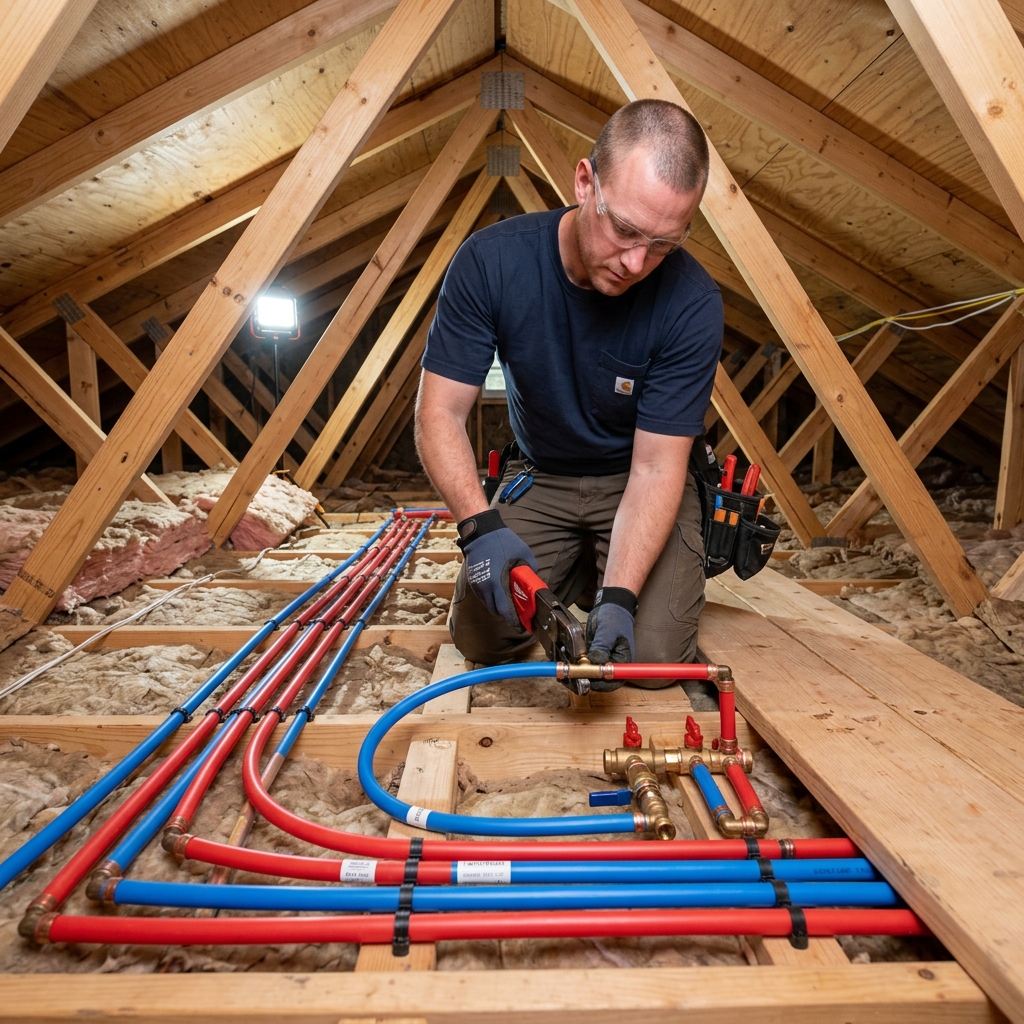
This concern is understandable, but in most cases it is not the reality of a professionally executed repipe in Coral Gables. Our primary approach for virtually all single-story and two-story residential repipes is attic routing: running new supply lines through the attic space above the living area, then dropping them down through interior wall cavities to reach fixtures, avoiding any need to open finished wall or ceiling surfaces.
Here is how the attic routing method works in practice:
- New main supply lines and branch lines are run through the attic using PEX-A flexible pipe, which can navigate around trusses, HVAC equipment, and insulation with minimal disruption.
- Drop lines from the attic to each fixture location are threaded down through interior wall cavities using fish tape and specialized tools, typically requiring only a small access hole at the top of the wall inside the attic and a small opening at the fixture stub-out location.
- The original under-slab or in-wall supply lines are capped and abandoned in place — removing them is unnecessary and would cause far more damage than leaving them.
- The result is a completely new supply system with zero disruption to finished floors, walls, ceilings, or exterior surfaces.
This method is particularly effective for the historic single-story and two-story stucco homes common throughout Coral Gables, where attic access is generally excellent and wall cavities are accessible from above. Our crews are highly experienced in working within the spatial constraints of these historic properties while fully respecting their architectural integrity.
Miami-Dade WASD Code Compliance for Repiping
Any whole-home repipe in Coral Gables must comply with the Miami-Dade County Water and Sewer Department (WASD) plumbing code, as well as the Florida Building Code Plumbing volume. Key compliance requirements for repiping projects include:
- Licensed contractor requirement: All repipe work must be performed by or under the direct supervision of a State of Florida licensed plumbing contractor. Homeowner self-permits are not available for repipe work in Miami-Dade County.
- Permit and inspection: A plumbing permit must be pulled from Miami-Dade County Building and Neighborhood Compliance before work begins. A rough-in inspection by a county plumbing inspector is required before walls are closed and a final inspection is required upon completion.
- Approved materials: Only materials listed in the Florida Building Code as approved for potable water supply are permitted — including PEX-A, Type L copper, CPVC, and others. Polybutylene is explicitly prohibited.
- Pressure testing: The completed new piping system must pass a hydrostatic pressure test witnessed by the county inspector before approval.
- Backflow prevention: Miami-Dade WASD requires specific backflow prevention devices at the water meter for all residential services, and any repipe must maintain compliance with these requirements.
At Plumbing Coral Gables FL, we handle every aspect of code compliance — pulling the permit, scheduling inspections, coordinating with the county inspector, and providing all required documentation — as a standard part of every repipe project. You will never need to navigate the permitting process yourself. Our repiping service page explains the full process in detail.
What to Expect During a Whole-Home Repipe
One of the biggest hesitations homeowners have about repiping is the fear of major disruption to daily life. Here is a realistic picture of what a whole-home PEX-A repipe in a typical Coral Gables home involves:
- Duration: Most single-family home repipes in Coral Gables take 1 to 3 days for installation, depending on home size and complexity. Water will be shut off to the home during working hours on installation days but restored each evening.
- Access requirements: Our crew needs attic access and access to all fixture locations. Furniture near vanities, under sinks, and around water heater areas should be cleared beforehand.
- Drywall patching: In most attic-routed repipes, drywall openings are minimal or nonexistent. Where small access holes are required, our team patches and textures them as part of the project.
- Inspection: After installation, we schedule and coordinate the county inspection. This typically takes 2–5 business days in Miami-Dade County.
- Final walkthrough: After passing inspection, we conduct a full walkthrough with you, demonstrating every new fixture connection and explaining maintenance recommendations for your new piping system.
Stop the Cycle — Call Plumbing Coral Gables FL Today
If you recognize one or more of these seven signs in your Coral Gables home, do not wait for the next leak — or for a catastrophic pipe failure that floods your floors, destroys your belongings, and costs tens of thousands of dollars in water damage remediation. The longer a failing pipe system is allowed to operate, the more damage accumulates — in pipe walls, in wall cavities, and beneath your foundation.
At Plumbing Coral Gables FL, we are licensed master plumbers with deep expertise in whole-home repiping throughout Coral Gables, including zip codes 33134, 33146, and 33156. We bring experience with the specific pipe materials, water chemistry challenges, architectural characteristics, and code requirements unique to this market. Every repipe project we complete is fully permitted, inspected, and backed by a comprehensive warranty on both materials and labor.
We offer free, no-obligation repipe assessments for homeowners throughout Coral Gables. Our master plumber will inspect your existing piping, review your leak history, perform a pressure test, and give you an honest, detailed recommendation — with full pricing — so you can make the right decision for your home and your family.
Call us right now at (305) 901-6544. Our team is available to schedule your free assessment and get a trusted, licensed expert eyes on your plumbing system before the next leak becomes a disaster. Protect your Coral Gables home — call today.